Insight Flow
Every idea submitted disappeared into a spreadsheet. Nobody knew what happened next.
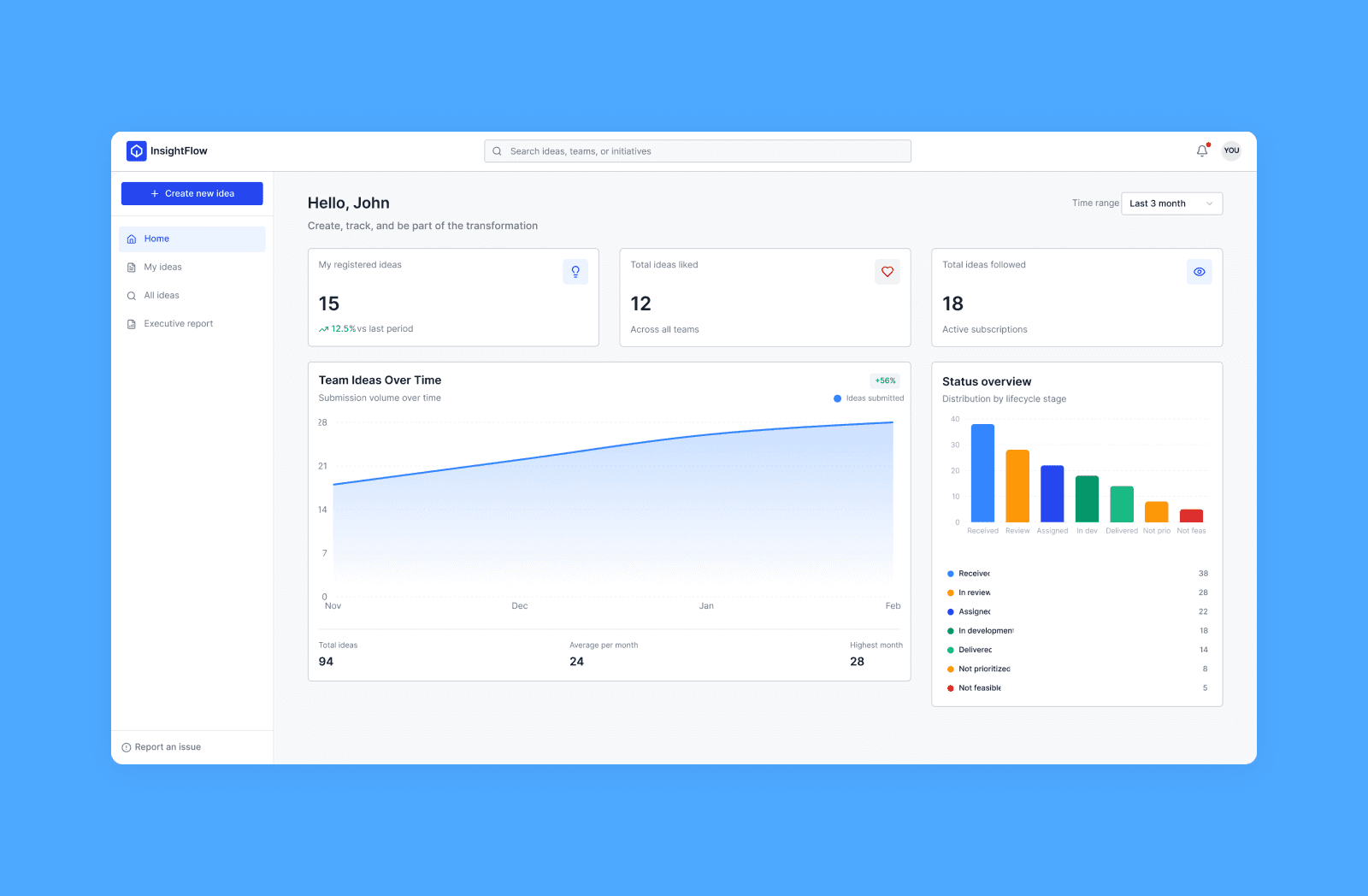
I redesigned the platform that changed that: 40,000 frontline managers, triage time cut by 80%, operational costs halved.
−0%triage
analyst time · 25 min → 5 min / idea
−0%cost
operational cost · automation driven
My role
Senior Product Designer
Timeline
4 months in production
Responsibilities
- Product Strategy
- Design Lead
- Research
- Visual Design
- Prototyping
Overview
InsightFlow is an internal idea management platform for 40,000 frontline managers. When I joined, it had a vendor dependency, unpredictable costs, and a manual triage process that couldn't scale, and trust was eroding because submitted ideas seemed to disappear.
I led the full redesign across two phases. The core tension: more structure improves triage quality, but it kills frontline adoption. I had to resolve both sides without sacrificing either.
I applied AI selectively, only where it reduced measurable cost or manual effort, and validated every decision through controlled rollout before scaling.
01. Context
A platform that captured ideas but couldn't process them
The platform had been rebuilt around automation, but the workflow became more complex, not simpler. Frontline managers spent more time filling forms than sharing ideas, and process engineers spent more time triaging than deciding.
PROCESS FRICTION
Too many steps to submit one insight
Analysts had to fill in 6 manual fields before submitting a single report, even when the AI had already flagged the issue.
Time to submit8 min
REVIEW BOTTLENECK
Triage took longer than the analysis itself
Each submission required cross referencing 4 panels. Leads spent 25 minutes per report just to approve or escalate.
Time to triage25 min
These two constraints compounded each other: slow submission reduced analyst throughput, while slow triage created a growing backlog that the team could not clear manually.
02. Problem Statement
The platform worked as a repository. Not as a decision tool
When I mapped the system, ideas were submitted but rarely acted on. Progress visibility was low, evaluation was manual and fragmented, and leadership had no way to see what was moving.
SECURITY RISK
External vendor with no data governance and unpredictable vulnerability exposure.
OPERATIONAL COST
R$151k/month recurring contract, with improvements locked until 2026.
PROCESS INEFFICIENCY
Manual triage fragmented across spreadsheets, consuming 25 min per idea.
"I need a faster, more practical way to submit my ideas. My time is short, and I'd like to be recognized for it."
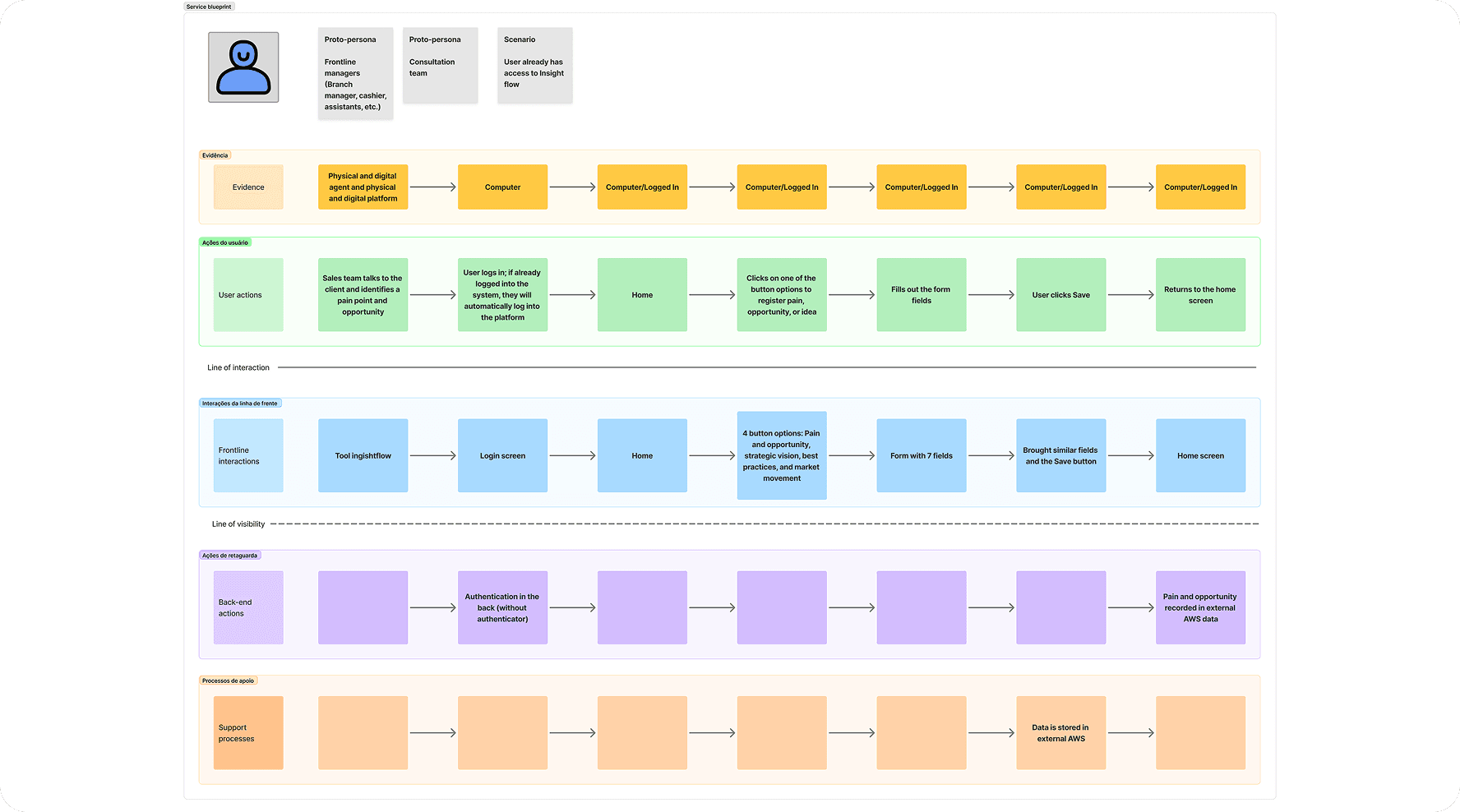
First Blueprint, to understand the service process behind the product.
03. Goals
Two audiences. One system. Zero tolerance for operational debt
I identified two audiences with conflicting needs and designed a sequenced response, prioritizing adoption before governance.
For the commercial frontline
REDUCE FRICTION
From 10+ min to under 1 min. Ideas captured in the flow of real work.
DRIVE RECOGNITION
Make contributors feel seen through visibility, status and acknowledgment.
For the process engineers
AUTOMATE TRIAGE
AI classifies and clusters. Humans keep the final decisions.
CUT OPERATIONAL COST
Eliminate vendor dependency. From R$151k to R$75k/month.
04. Roadmap and Discovery
Six weeks of structured research before a single screen
WEEK 1 AND 26 Stakeholder Workshops
Blueprint, CSD matrix, empathy map, outcomes map
WEEK 37 User Interviews
2 commercial managers + 5 branch managers across Brazil
WEEK 4 AND 5Wireframe + Usability Test
Single wireframe · SUS 80 before launch
WEEK 6Handoff + Rollout
100 hard users · First controlled deployment
The workshops revealed the core failure: every idea submitted felt like shouting into a void. Managers didn't know if anyone read it, acted on it, or why it was rejected. The design problem wasn't submission. It was the absence of response.
05. Strategy
I chose to sequence. Not everything at once.
Two paths. Two different failure modes. I mapped both before committing to either.
FAILURE MODE 1: Big bang launch
Ships complete, but nobody uses it
Adoption dies before feedback can improve the product.
FAILURE MODE 2: Partial launch
Ships simple, and slowly becomes debt
Triage scales faster than the solution. Operational debt compounds.
THE SOLUTION
Phase 1: unlock adoption.
Reduce submission friction so ideas flow in from the frontline without effort.
Phase 2: add structure + automation.
Unify triage, introduce AI where it reduces manual cost, close the feedback loop.
One before the other, not both at once. Adoption first, then governance.
What tradeoffs shaped the final design?
What I chose, and why it mattered.
How did AI cut triage time by 80%?
I applied AI selectively, only where it reduced operational cost.
I didn't treat AI as a feature. I built a classification agent against a RAG from each business area's theme library, routing ideas with the precision of someone who knew the taxonomy, without requiring users to know it themselves.
What AI does
Theme/subtheme classification
Auto-classifies from natural language. No taxonomy expertise required from users.
Similarity detection
Surfaces similar ideas in real time during submission, after user starts typing.
Writing assistance
Reformats free text before submission. Improves triage clarity.
Summarization + clustering
Automates idea grouping. 25 min → 5 min per idea (−80%).
Human accountability preserved
Final routing decisions
Stakeholder teams own the decision. AI suggests, humans approve.
Quality monitoring
Ops team reviews edge cases. A fallback is always available.
Override on demand
Any classification can be corrected by the operations team.
Governance model predefined
Accountability structure defined before implementation begins.
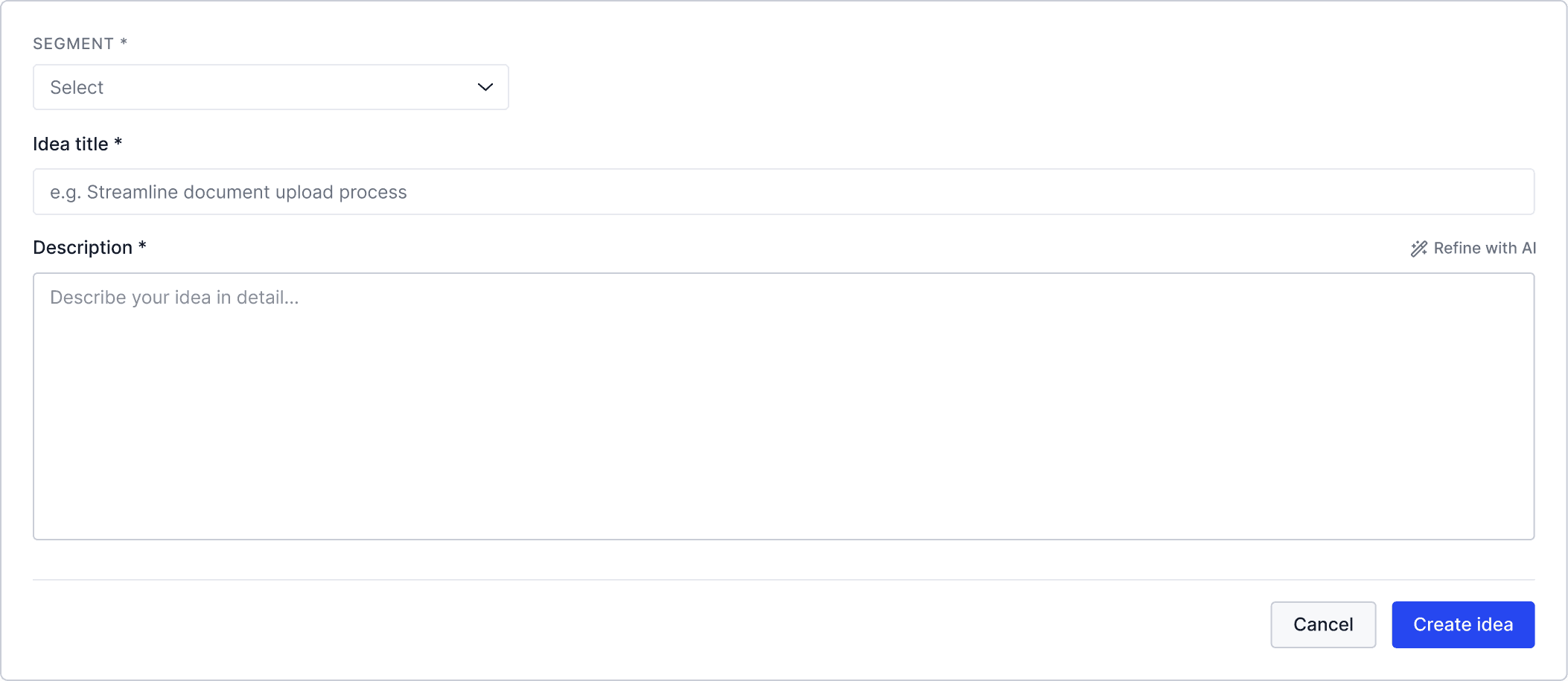
Three fields
Segment is the minimum viable classification. Everything else is resolved by AI after submission.
Faster outputs
60% of managers refined ideas in ChatGPT before submitting. ‘Refine with AI’ brings that behavior into the platform.
Three fields
Segment is the minimum viable classification. Everything else is resolved by AI after submission.
Faster outputs
60% of managers refined ideas in ChatGPT before submitting. ‘Refine with AI’ brings that behavior into the platform.
Idea ID
Every idea gets a unique ID. Frontline managers track it. Process engineers route it.
Status
‘In review’ signals the idea entered the process, not a void.
Comments
The idea becomes a conversation, not a ticket waiting for approval.
Likes
The most requested feature in research. Peer recognition before leadership decides.
Theme and Subtheme
AI has classified and the form stays simple, the modal shows the result.
Owner
Managers track who created it. Process engineers need it for the awards.
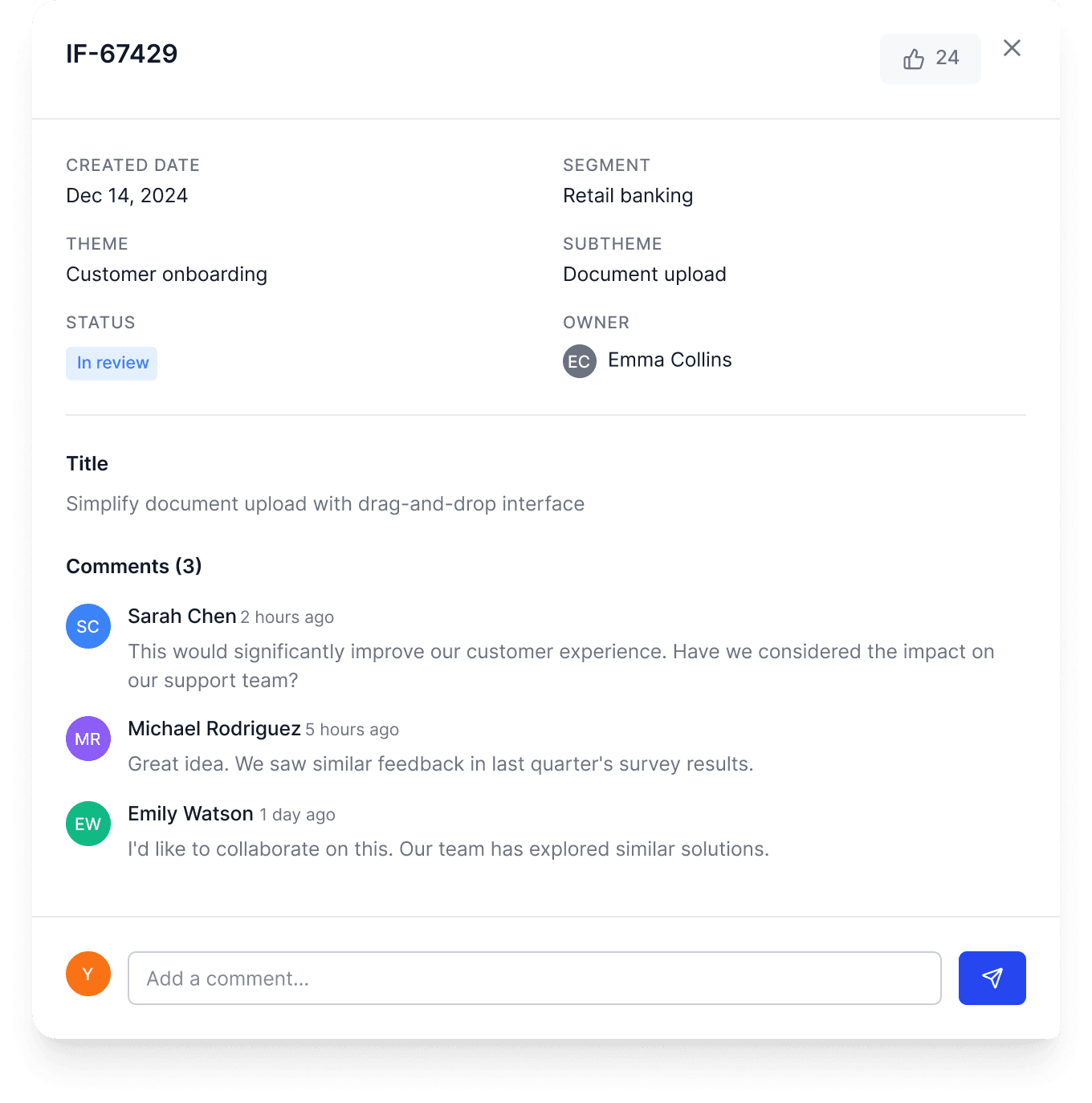
Idea ID
Every idea gets a unique ID. Frontline managers track it. Process engineers route it.
Status
‘In review’ signals the idea entered the process, not a void.
Comments
The idea becomes a conversation, not a ticket waiting for approval.
Likes
The most requested feature in research. Peer recognition before leadership decides.
Theme and Subtheme
AI has classified and the form stays simple, the modal shows the result.
Owner
Managers track who created it. Process engineers need it for the awards.
06. Rollout
Controlled rollout. Validation at every threshold
PHASE 1100 pilot users
CSAT 95.8%Power users from each region. Daily feedback loop.
PHASE 220,000 users
CSAT 97.08%Broad regional rollout. Monitoring CSAT weekly.
PHASE 340,000 users
CSAT 97.85%Full national deployment. KR milestone hit.
CSAT grew as the platform scaled, KR: 139.79% of target hit. Satisfaction improved at every threshold. Adoption first, then governance validated the approach.
07. What shipped
From decisions to deployed
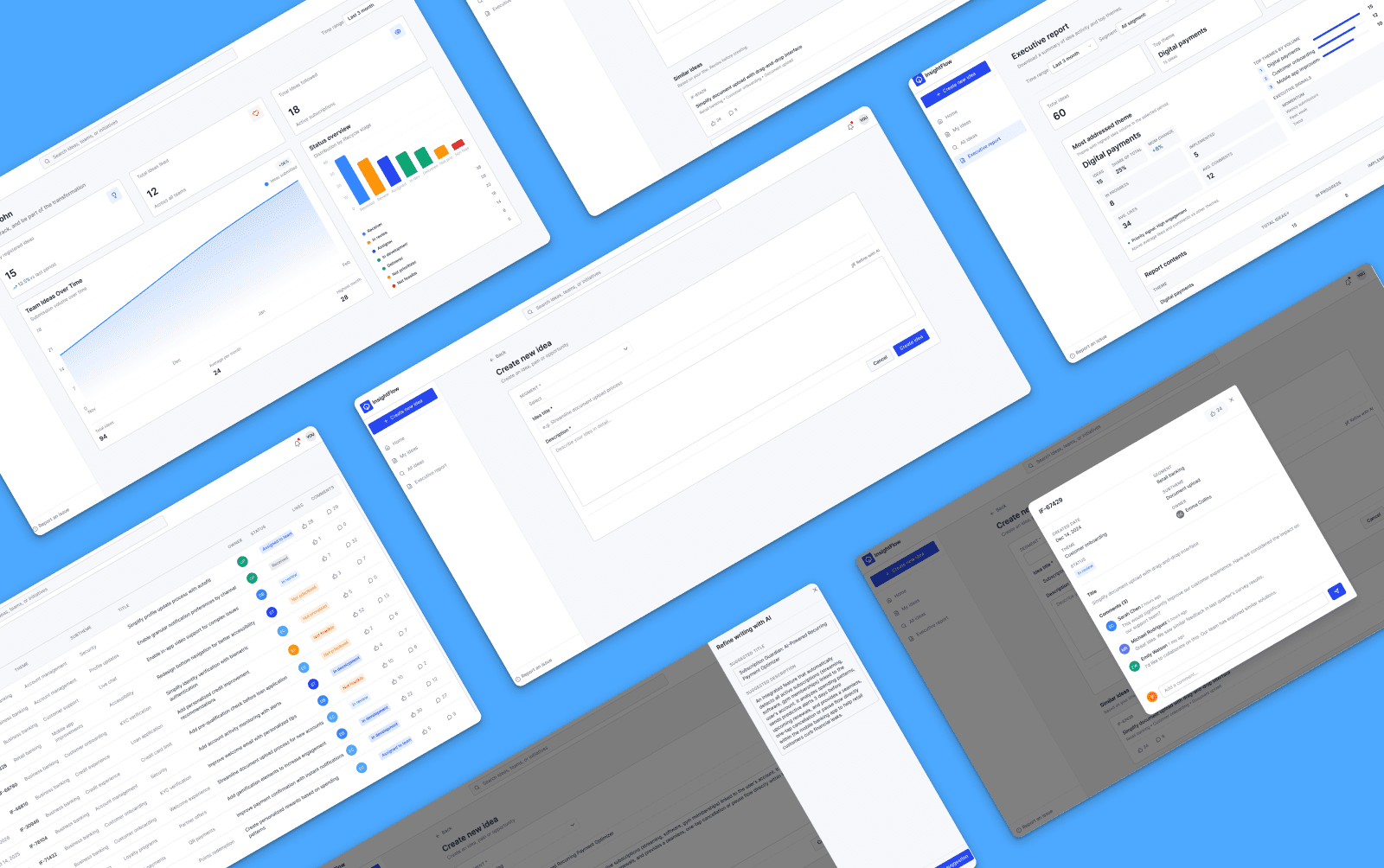
Every screen below went through at least two rounds of usability testing and one round of stakeholder review before reaching production. This is what 40,000 users opened on day one.
08. Business and User Impact
Complexity reduced. Clarity shipped.
I shipped to 100% of frontline managers within three months of launch. Adoption reached 95% in week one. The same managers who said their time was short gave it a 97.85% CSAT.
"I've never seen a project finish on time and deliver exactly what was planned."
Beyond the numbers, frontline managers reported feeling heard for the first time, and the operational team finally had a process they could trust.
0SUS scoreUp from 52, top 10% of enterprise tools
0.00%User satisfactionCSAT at full 40K user rollout
0.00%KR achievedCSAT growth exceeded the original target
−0%Triage time25 min → 5 min per idea
09. What's next
The platform shipped. The product isn't finished.
Shipping to 40,000 users surfaced what the data didn't show in testing. I documented two horizons of work — what needed attention immediately, and what would expand the platform's strategic value.
Now (1 month)
Improve edge-case operational flows
A small percentage of ideas fell outside the classification taxonomy. I mapped the failure paths and proposed fallback routing logic for the triage team.
Strengthen decision traceability
Triage decisions had no visible audit trail. Process engineers couldn't review or challenge a routing call. I designed a decision log pattern to surface history without adding friction.
Reduce submission feedback latency
Ideas entered a black box after submission. The fix wasn't a notification system, it was exposing the pipeline state in a way that felt natural to the submitter.
Next (Quarter)
Expand AI summarization for evaluations
The classification layer was phase one. The next layer is summarization, surfacing patterns across idea clusters for the process engineering team, reducing review time for batched submissions.
Add adoption and throughput dashboards
We tracked CSAT and triage time, but couldn't see idea velocity by region, submission quality trends, or drop-off by step. A lightweight dashboard would close that loop.
Design executive reporting for process engineers
Triage was solved in phase 2, but the accountability loop with leadership remained open. I mapped the next design surface: an exportable executive report with date filters and cluster summaries.
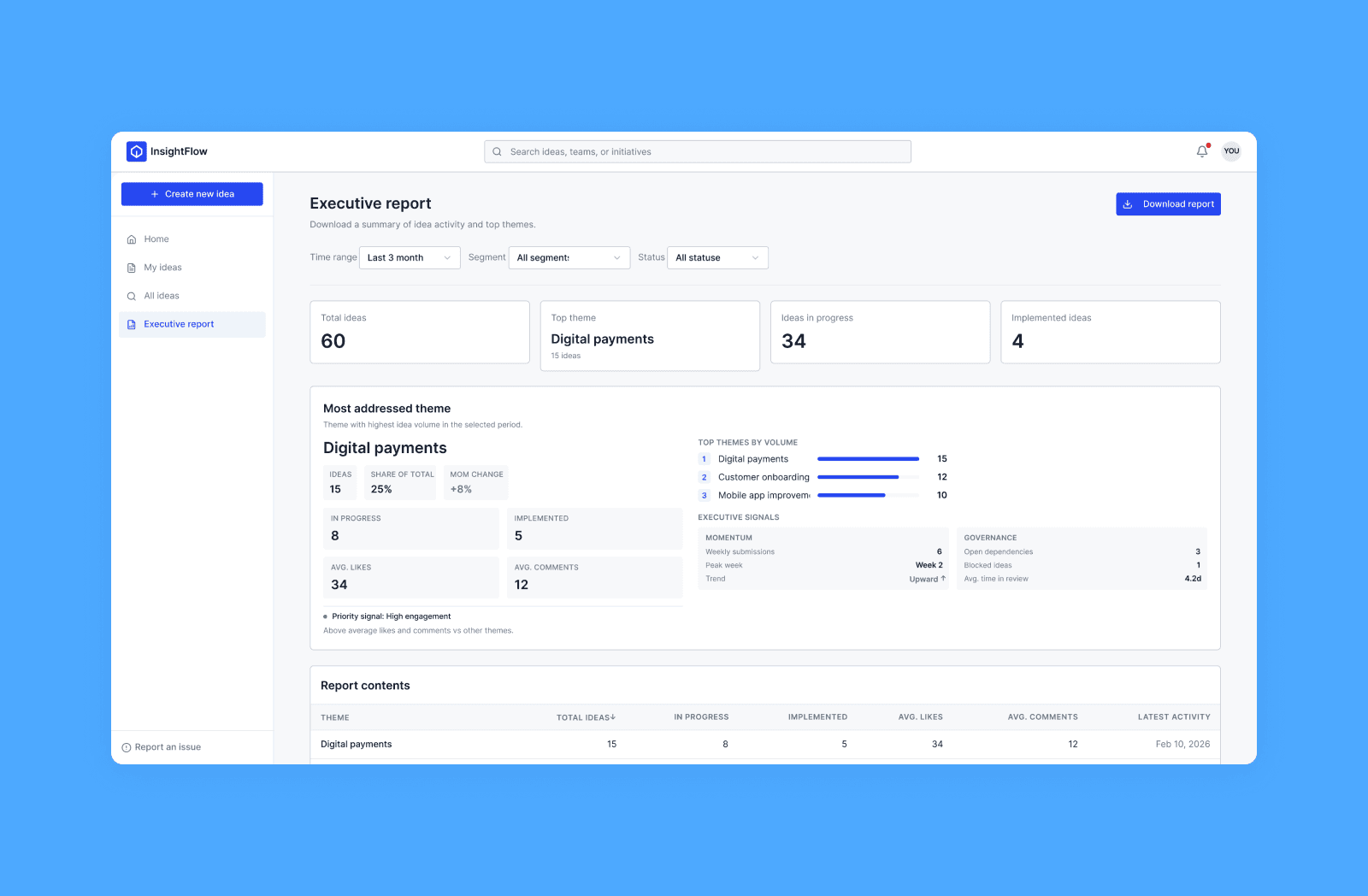
Executive report, concept exploration. A dedicated reporting surface for process engineers: idea volume, top themes, and implementation rate in one exportable view, the accountability layer the platform was missing.
10. Learnings
What I'd carry into the next complex system.
Not conclusions, decisions I'd make again, and ones I'd make differently.
OWNERSHIP
This project had minimal leadership involvement, and produced some of my strongest stakeholder results. My name was most cited in feedback sessions. The learning: design impact scales when the designer owns the outcome, not just the scope.
PLATFORM
Process engineers didn't need a new tool, they needed the right configuration. We chose the native platform with custom attributes over a custom build: faster to ship, cheaper to maintain, and validated by research before we built it.
AI
The classifier was built on a triage taxonomy, not how frontline managers think. 60% of users were also refining ideas in external tools: behavioral signal I only had in production. Both gaps belonged in discovery.
ROLLOUT
Month 1 with 100 users changed what we built in month 2, but I treated it as controlled deployment, not a research phase. The principle I'd apply earlier: pilot phases should have explicit hypotheses, not just a smaller audience.